Point/Counterpoint: Meat vs. Plants

Editor’s Note: Longtime ES reader Thresher was moved to write a response to Amcstang’s recent thoughts on the Paleo Diet. We love us a good controversy.

Paleo Diets are one of my pet peeves. It’s such a brilliant idea at the core, but none of the popular versions of it hit at the nugget of scientific truth that should be emphasized: caloric restriction works pretty well (we evolved being very, very hungry for most of the average year) and probably is one of the few approaches to eating that will demonstrably make the average person live longer. But it’s hard to enjoy, and there aren’t many food blogs that can be built around like 1,000 calories per day.

Let me frame that rant. I had a reaction to a previous Endless Simmer post. It was on the topic of a particular type of the Paleo Diet ethos, and I couldn’t help but grit my teeth while reading it. I thought I’d offer a response, for good measure, from the perspective of the epidemiologists and biologists (etc…) who’ve been seriously studying diet and quality of life for decades.

‘Diet’ strikes many of us as a four-letter word because there are so many of them out there, each hawking a particular (amazing) benefit. “Eat only magic cookies!” “Lose 80 pounds through cheese!” “Live forever young!” As much as we tend to desire these very gratifying claims, we also roll our eyes at the commercials that brag about them because, deep down, they seem at least a little bullshitty.

So, yes, there are a lot of opinions out there on how to eat well, and it’s hard to call any of them flat-out wrong. That’s because faddish diet plans tend to focus on achieving a particular goal, in the short term, and sometimes they can achieve that goal really well. There are fad diets that will make you skinnier, bulkier, leaner, even sexier and more tan. But they’re called fads for a reason: after an initial quick success, they don’t end up doing anything good for your body in the long run (and sometimes they can do some serious damage, or at the very least make you fatter than when you started).

Forget all that. I can summarize in a couple sentences the big picture on diet and health that we pretty much know is true—from science! I swear I’ll be quick with a few facts and then we’ll get to some yummy stuff.

Read More

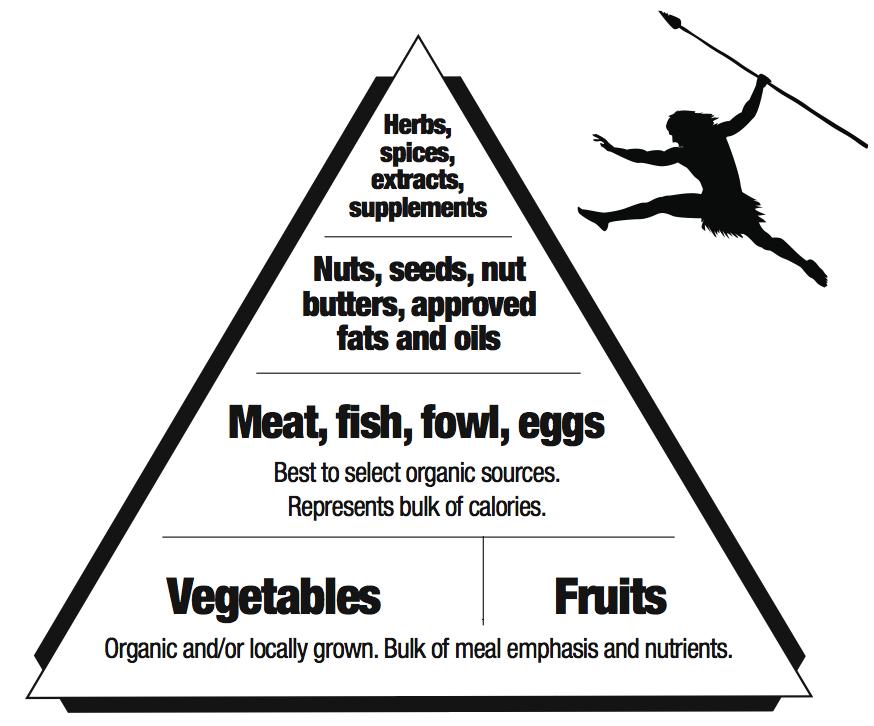
Hunt, Gather, Avoid Grains: The Caveman Diet

Ed Note: Our friend Amcstang is a caveman. Or at least eats like one. The Paleo diet receives much praise, and even more criticism, recently ranking “unsafe” at #18 on list of popular weight loss programs. Here’s his pitch on forgoing carbs, living CrossFit and going ancestral. 

Only a year ago walking down Wilmington Avenue in Rehoboth Beach, DE at 8 AM, I would have chosen Dave & Skippy’s Gourmet Bagel and Sandwich Shop ten out of ten times for breakfast—promising whole grain bagels, gourmet cereals and fresh wraps—over Gus-N-Gus next door selling fried eggs, sausage and bacon off a flat-iron griddle on the boardwalk. I mean, Skippy’s was clearly the healthy alternative based on years of ‘advice’ from the USDA, FDA, and multi-national food companies.

Fast forward one year and I don’t even think twice about my breakfast choice: Gus-N-Gus with their greasy spoon approach, hands-down. No, I haven’t given up “eating healthy” and no, I don’t weigh 300 pounds and do my dishes in my own bathtub. In fact, I am pretty confident in saying that I am the healthiest and in the best shape of my life at age 29.

Without trying to attach a trendy label to my eating habit, I went Paleo.

Read More

Four Sophisticated Ways to Green Your Kitchen

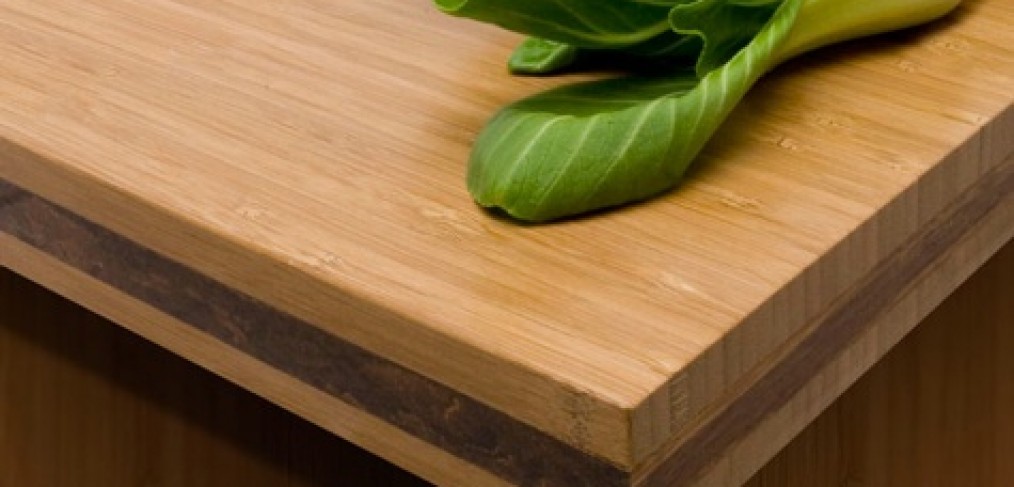
Sustainability and eco-consciousness might be more relevant in the kitchen than any other room in the house. The kitchen is where technology lives side by side with organic elements and together they coexist and do daily duty – feeding both mind and body.

Here’s a list of some products and appliances that perform well, look great, and have the additional benefits of helping your home become more efficient, use less energy and turn your kitchen green.

1. Check Under the Hood

Most homeowners tend to default to whichever hood their local showroom sells them with their range, or whatever hood is already installed in their homes.

Zephyr’s new Next Generation Europa Collection with DCBL Suppression System is not only beautiful, but energy efficient. The DCBL Suppression System uses a direct current (DC) brushless motor rather than an AC motor which is why Zephyr’s hoods consume 77% less energy. This same motor provides 30% more power to the hood, but it’s also 77% quieter. The collection also uses a dimmable LED— an industry first— which is called Bloom HD LED and offers 25,000 hours of life versus 2,000 offered by halogens. And for all those roving hands in the kitchen, it’s cool to the touch.

Bonus: If you are already a Zephyr hood owner – and are interested in showing off your uber-cool hood – Zephyr is running a contest right now called Inspire My Kitchen Design Contest , which awards homeowners prizes. The grand prize is Chef Tom Hurley preparing dinner for up to 16 of your friends in your home.

2. Lighting the Way

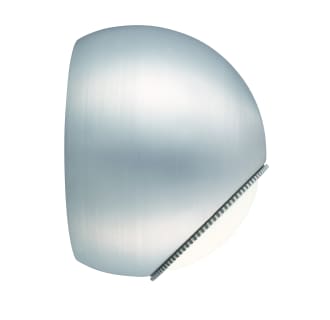
Lighting choices is a much more complicated decision these days. LED lights, which at first seemed prohibitively expensive, have come down in price and are better for the environment. LED bulbs are lit solely by the movement of electrons. Unlike incandescent, they have no filament that will burn out; and unlike CFLs, they contain no mercury or other toxic substances. LEDs can last some 60 times longer than incandescents and 10 times longer than CFLs. Creative Systems Lighting offers plenty of LED options, including Orb, which features a rotating aluminum body and LEDs that use at least 75% less energy than incandescent bulbs and last up to 50 times longer.

Read More

Food Fights: The Difference Between Cheesesteak and BBQ Lovers

Ed. Note: Long-time Simmer favorite Belmontmedina is pretty pissed off about what a certain Washington Post reporter tweeted yesterday. Let the rant begin.

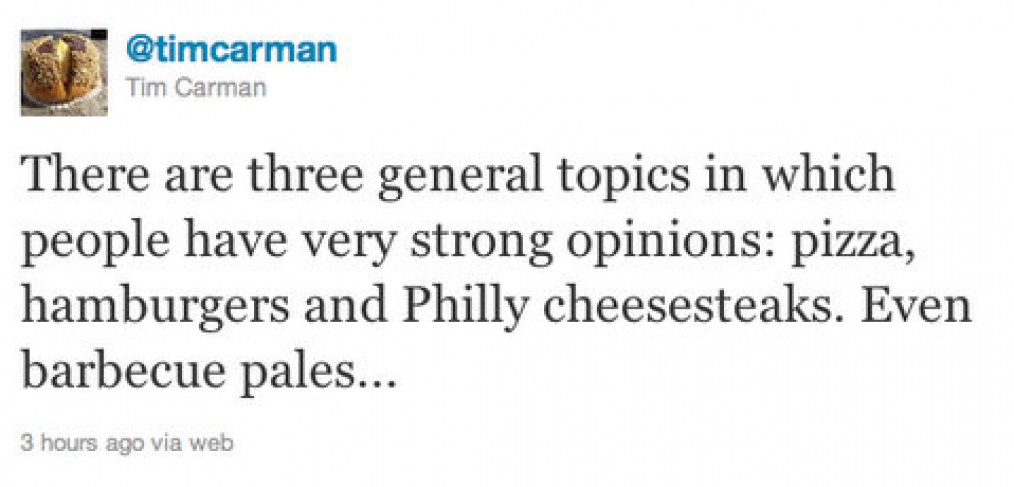
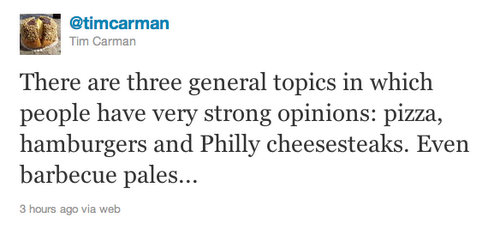
The Washington Post‘s Tim Carman (who I am quite fond of, since his days helming the food coverage at Washington City Paper) ventured this opinion on twitter yesterday, pictured above.

FALSE.

Pizza and burgers I get. I am obsessive about pizza. Everyone has a favorite crust, preferred toppings, feelings about sauce (classic Neapolitan with buffalo mozz for me please). And burgers…well, you’re talking to a girl who stuffs various cuts of meat in her grinder like a mad scientist (chicken burgers are actually quite tasty with ground thighs). But Cheesesteaks? Not igniting the passion of BBQ? Please.

Let’s examine, shall we?

Pizza and burgers are pretty universal, with various regions claiming various styles. So it makes sense that pizza and burgers would inspire strong convictions across the board. But I am under the (perhaps mistaken) impression that no one outside Philly and its immediate environs cares about cheesesteaks. (Except, of course, for those transplants that insist on irritating the rest of us by going on and on about cheesesteaks and the Eagles– sorry gansie).

But I’ll be charitable. Let’s give the cheesesteak-ers the Eastern seaboard from DC to Boston and the entire state of Pennsylvania, although I hear Pittsburgh is more Primanti Bros. than cheesesteak. Done.

Moving on to BBQ. I think we can all agree it inspires great passion. There are books. There are maps. There is an episode of Good Eats. You can immediately tell where someone is from based on their barbecue allegiance.

Read More

Small Plates Get Smaller: Pinxto in Basque Country

DSC_0405

San Sebastian

Ed Note: Our friend Jake recently returned from the Basque Country, eager to tell me about his love affair with food from the region. I think he might have even said it was his favorite cooking from around the world. 

DSC_0383

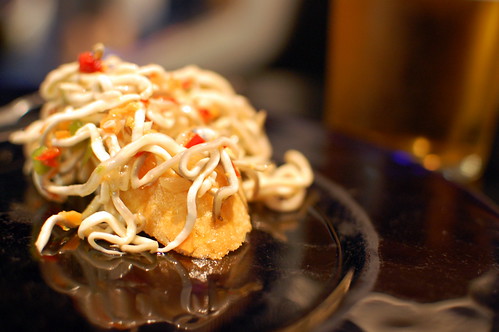
Baby Eel

And Jake’s been around, growing up in Philly, living in Boston, DC and Portland and traveling through Asia and India and many more places.  Especially, Costa Rica, where he toured with teenagers around the hills, farms and lakes of the country. He also wrote about it on Simmer a few years ago. Here are a few highlights from his taste of the Basque Country. 

DSC_0344

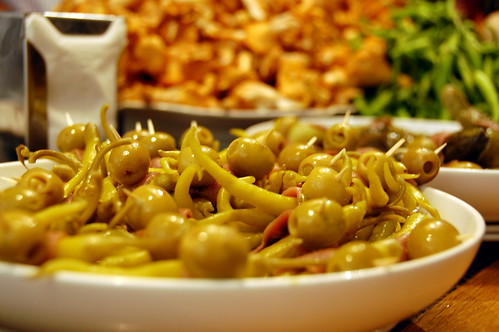
Beans, Jamon and Olives

Basque Country (Pais Vasco) claims to be neither a part of Spain nor France, rather an independent region with its own take on how eating should be done. I like.

DSC_0348

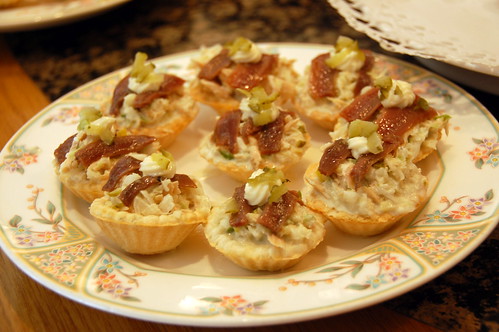
Anchovies

I’m pretty sure everyone knows tapas, you sit down to eat with a few friends, share a few small plates and leave hungry and feeling like you overpaid. I get it.

DSC_0429

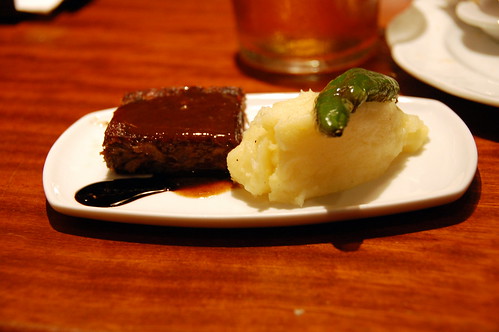
Oxtail, Mashed Potato, Pepper Guernika

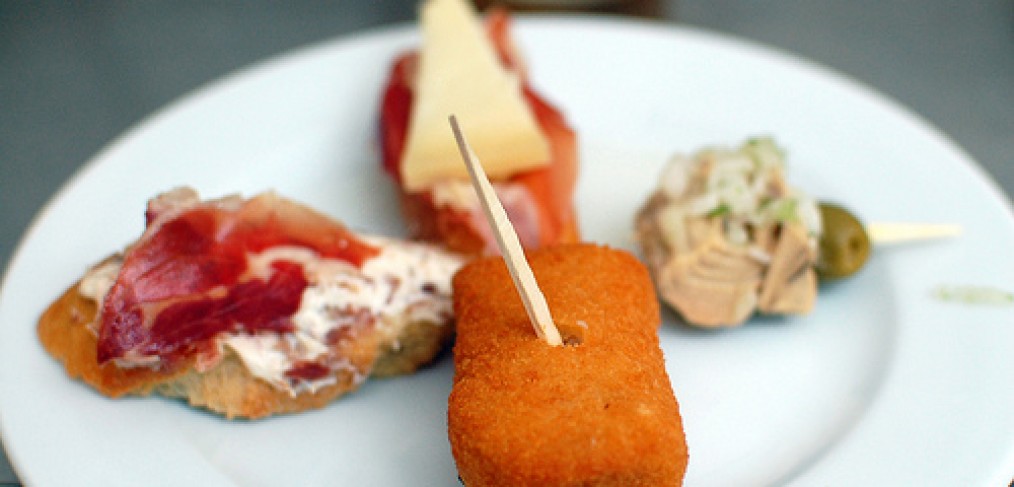
Enter pinxtos (pronounced pinch-os).

Read More

Christmas in August: Pickled Watermelon Rind

Ed Note: Our friend Julia, canning lover and far mar worker, is back to rant about a newly acquired, and blogger-inspired, cookbook. Julia’s previously written about roasted rhubarb and Meyer lemon syrup.

Discovering my inner Southern grandmother has opened up my cookbook addiction in a whole new direction: canning and preserving texts now fill my shelves. Apparently many, many others have also become a part of this “canvolution” (not my word – I swear) and so a whole crop of canning books are popping up. As such, it seems that all sorts of canning bloggers are scrambling to write books to cash in on the craze.

For those of us who love cookbooks, but hate to follow recipes, canning presents a unique challenge in that, not following a recipe or procedure to a “t” can result in some really nasty things.  Like death.  From botulism.  Not a pretty way to go.

As a result, every canning book that I have come across lately has – rightly – dedicated a good amount of space to describing the process of canning safety measures and the history of various methods.

The most recent canning book to my collection, WE SURE CAN! How Jams and Pickles Are Reviving the Lure and Lore of Local Food (courtesy of Arsenal Pulp Press) does not break from that format.  In fact, author Sarah B. Hood spends 60ish pages writing about the history of canning…Then the resurgence of canning…Then the people responsible for the resurgence of canning…. Then the way to can…

And then (YAY!) we get two recipes.

Read More

Nothing Like a Little Revenge Cooking

Ed. Note: Our friend Julia, the pending med student and far mar worker, tells us what to do with that mysterious rhubarb. Julia previous spun Meyer lemons into syrup.

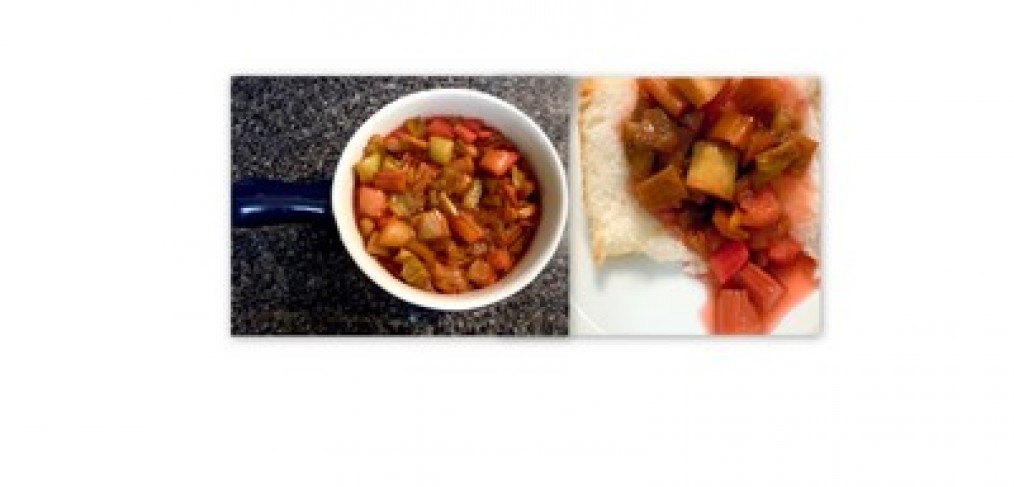
Last Saturday when I was working at the Mt. Pleasant Farmers Market, I spent all day singing the praises of rhubarb. I then realized that all I ever do with it is make crisps, so I decided to branch out and started searching for other things. Plus, my co-worker Nick thinks it’s a dumb vegetable, and very over-hyped, so I was trying to prove him wrong. Nothing like a little revenge cooking.

I love rhubarb because it adds something unexpected to sweet deserts. It takes on the sweetness, but also is fresh and bright and slightly sour. It just tastes like spring to me: new and tangy. I have to say, I think this roasted rhubarb recipe could be the gateway drug for the gorgeous magenta stick. And it’s going to be hard for me to go back to my normal crisps after this. It was so, so good.

Roasted Rhubarb with Vanilla and Orange

Read More
« Previous