

Turquoise Arches, the only non-golden arches in the world — found in Sedona, AZ.

Turquoise Arches, the only non-golden arches in the world — found in Sedona, AZ.


If you’ll continue to indulge me here on my whirlwind world tour, ESers, I’m currently on my way back home from Africa and decided to stop over in London for a few days (it’s on the way, right? Well, kind of.) Anyway, it’s a hot thing in the food world right now to talk about how British food isn’t as horrible as it used to be; how Jamie Oliver, Heston Blumenthal and the gastropub explosion have finally made England safe for foodies. Of course, personally I was less interested in hearing about what celeb chef does the best high-end pigeon plate, and more into figuring about whether or not this newly foodified country knows how to make a proper sandwich.
First stop: Borough Market, the weekly food fest just south of Tower Bridge, where I spied some lovely slices of halloumi doused in garlic and lemon cooking up on the grill. I’ve mentioned the glories of grilled halloumi on the blog before, but let’s pause for a rant: why is this delicious cheese so sparsely available in the US? Yes, you can find it in high-end stores sometimes, but it usually costs $9 and I almost never see it in restaurants. In Europe, and oddly, also in Africa, you see halloumi all the time on salad and sandwich menus, and it’s not particularly pricey. I know it’s not a U.S. cheese, but really, we have all kinds of Euro cheeses in the states, why are we so low on this one? I’m just saying, it really spruces up a salad or sandwich, and we need to get on that train. </rant>
Moving on — clearly, I wanted the halloumi as soon as I saw it. But then I had a twinge of travel eating doubt. You see, when traveling I always get hyper worried about making the wrong food decisions. I figure I only have a set amount of meals in each location, just get super nervous about blowing one by ordering something less than fantastic. Was halloumi really the right choice on my first day in London, especially when it’s not even a British food? I began to question my decision. The same stand also sold bacon butties, and the pork-y smell filling the air was raising serious doubt. Meat or cheese??? My food-travel anxiety kicked into high gear.
Then of course, I remembered I’m American and that I don’t have to choose.
“Could you make me a sandwich with bacon and grilled halloumi on it?” I tentatively asked the sandwich cook, wondering if he would scoff at my foreign fattiness.
“Absolutely,” he replied. “Would you like the bread toasted?
“Yes, please.”
“Actually, would you just like the bread grilled in bacon fat?”
Oh, man. Now that is my kind of British chef.


OK, I know I said earlier this week that Tanzania doesn’t have an awful lot of food to write home about, but there is one dish you really do need to know about. Actually, it’s pretty much the de facto national dish of Tanzania and I have to declare that it is pretty damn amazing.
Anywhere you go in this country, you’ll see little makeshift stands along the side of the road, generally stocked with just two things:
1) A giant, wok-like bowl set over a fire, perpetually cooking up a new batch of french fries in a big ol’ pool of oil.
2) A crate of farm-fresh eggs.
So what exactly do they make at all of these mysterious egg and french fry stands?
They make a muthafuckin french fry omelet, fool! Doesn’t require much of an explanation, really. You just throw the french fries in a pan and re-fry them with a bunch of eggs poured around them. Depending on how fancy your roadside stand is, your french fry omelet might be served with a slaw of fresh vegetables, just with a few spicy pili pili peppers on the side, or sometimes you just get salt and ketchup. Also depending on how fancy the stand is, you might get a toothpick or two to break it apart and eat it with, or you might simply have to go ahead and barehand it. In Swahili it’s known as chips mayai (chips and eggs), and it can be eaten for breakfast, lunch, dinner, midday snack, midnight snack — really, it’s always acceptable, and I know exactly what I’ll be doing next time I find myself at home with leftover french fries.


Jambo, America. As some of you know, I have spent the past six weeks avoiding winter in Tanzania, East Africa. I haven’t blogged much, because I have to say that the food here is, for the most part, not crazy enough to write home about (no bacon-donut-fried-chicken sandwiches in Africa for some reason). However, this continent does have something that America most certainly does not: the very best fruit salesmen in the world.
You never have to look far to find a streetside stand selling avocados, mangoes, papayas, and all kinds of other tropical fruit. But the best part is that the fruit salesmen will always help you pick out the most ideal piece of fruit, depending on when you want to eat it. On my first avocado buying mission the day that I got here, I used my extremely limited Swahili (OK fine, I used mostly sign language), to tell the salesman that I wanted three avocados. He promptly picked out three avocados for me and, using sign language and Swahinglish, handed them to me in order of ripeness, instructing me that “this one is today, this one tomorrow, this one the day after tomorrow.” How great is that! The same thing happened when I returned to buy two mangoes — I was given one perfectly ripe one, and one almost perfectly ripe one. Can this happen in every supermarket in the world, please?
Anyway, this is all meant to lead up to a story about the craziest, most amazing (but really kind of simple) sandwich that I’ve eaten in Africa. On a trek through the beautiful, remote Usambara mountains, our guide introduced us to a surprising breakfast: one half of an avocado, plus one half of a banana, with a hefty helping of salt, rolled up in a chapati (Indian-style bread). I never thought to mix banana and avo before, but it’s really an ingenious combo–two rich, hearty fruits that play surprisingly well together, for a sweet, salty and savory sandwich. Paired with a slice of mango, I’d say it’s damn near a perfect breakfast.
Not sure whether or not it would be better with bacon.


When I stayed in Copenhagen earlier this year, the hotel breakfast spread fucking rocked.

Soft boiled eggs (with adorable holders and spoons), 5 different dark, seed-crusted breads, cereals, granolas, 3 different types of yogurt-ish products (samoa, soured milk) DIY fresh-squeezed – and ultra pulpy – OJ and sliced (fancy!) meats.

But most of all, I couldn’t get enough of the cheese. It wasn’t just slices, or a wedge or shreds.

But cheese hooked into this almost torture-looking device that easily slices cheese fresh from the block. I had just as much fun using the contraption as trying the various types of wonderful cheeses available. So, someone either fly me back to Copenhagen’s Scandic Palace Hotel or find me one of these machines.
Demonstration below:
More in Copenhagen Travels
Another year gone by, another chance to look back fondly at the thousands of things we stuffed our faces with in 2011. After much internal debate, we’ve narrowed it down to just 10 — the very best new things we shoved in our mouths in 2011.

Montreal’s greasiest, gravy-iest contribution to the food world, poutine officially became a trend back in 2010. It got even more amazing this year when chef Kyle Bailey of D.C.’s ChurchKey had the ingenious idea to replace the french fries with tater tots.
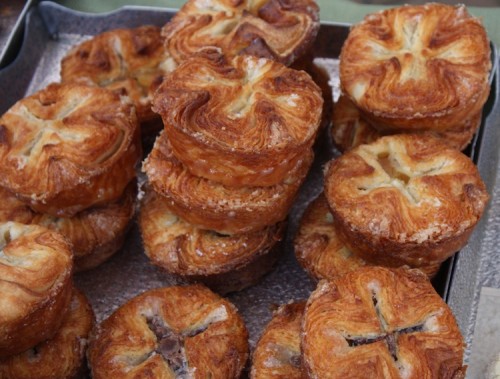
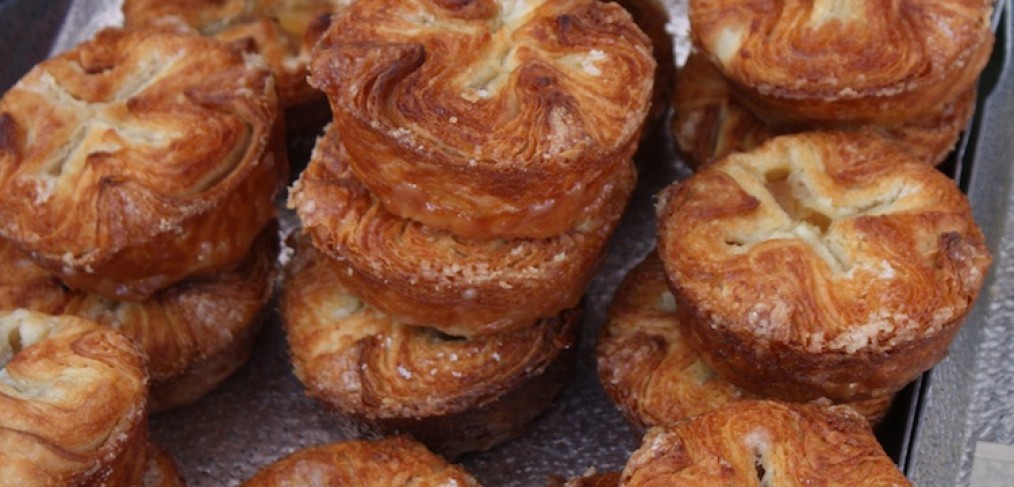
We first discovered this over-the-top traditional pastry, which is something like a croissant with twice as much butter and sugar, on a trip to Brittany, France this summer. Returning home, we were pleased to find it blowing up in the states. The best version we’ve tasted to far is the one above, from Starter Bakery in Oakland. It has also popped up at Dominique Ansel in New York and Bouchon Bakery in L.A.

Filipino food is among the most far-out in the world, so it was only a matter of time before it got a hipster update. From Adobo Hobo’s Filipino tacos in San Francisco to Maharlika’s spicy arroz caldo in New York (above), we’ll take all the creative Filipino cuisine we can get.
Read More›
Straight from Japan to Seattle: green tea flavored Kit Kat bars.

Very green, very sweet, very… herbal? And yes, they were delicious. Or as they’d say in Japan, oishii desu ne!